DualEntry vs QuickBooks
DualEntry is built for growth from day one. Manual workflows, limited controls, and fragmented reporting make QuickBooks unsuitable past early-stage growth.

Why companies switch
Multi-Entity Accounting
Companies move from Quickbooks to DualEntry automates multi-entity and high-volume accounting, supported by native, in-house integrations built and maintained by the DualEntry team, so finance teams can scale without adding overhead.
Automation that speeds close
Real-time accounting, automated reconciliations, and built-in controls, designed for responsive interaction (tested for ~250ms response times), deliver faster, more reliable financials.
Audit-to-IPO ready
DualEntry provides audit-ready reporting and enterprise-grade controls from growth stage through IPO.
See what sets us apart
Key Features |  |  |
|---|---|---|
G2 Reviews | 4.9  | 4.4 .svg) |
Migration | 24 hours | 1-3 days |
Integrations | +13,000 | |
Intuitive UI | ||
Responsive Interaction | ||
Multi-currency support | ||
Real-time transaction posting | ||
Customizable intercompany reports | ||
Consolidated exchange rates | ||
Automated amortization and depreciation | ||
AI intercompany netting | ||
AI-assisted bulk import | ||
Automated elimination and balancing | ||
AI-guided allocations | ||
AI payment matching |

Why these companies chose DualEntry


DualEntry implementation is quick and easy
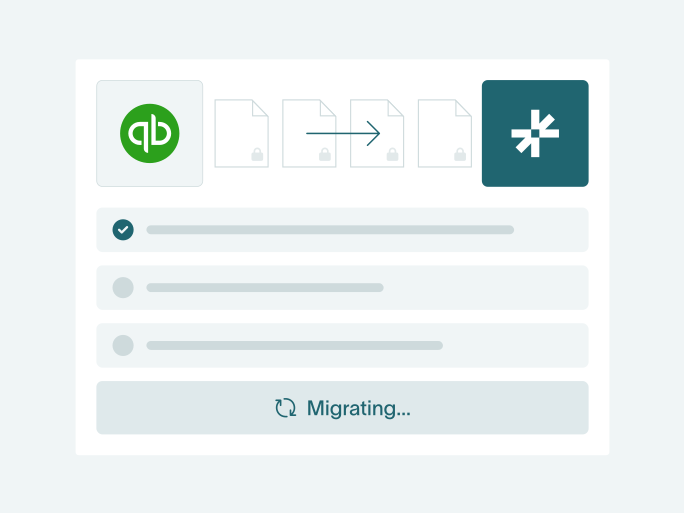
Seamless migration
Your data's encrypted and backed up while it's migrated to DualEntry. None of your data is changed in other systems during or after migration.
Implementation is always included
We sell software, not services – so we don’t profit from long implementations. Go live fast. Transparent pricing. No upsells.
Tailored to you
One size doesn’t fit all. That’s why we work with both pre-defined templates and customizable solutions, delivered through an intuitive, finance-first UI.

DualEntry vs QuickBooks FAQ
Is DualEntry a good alternative to QuickBooks?
Yes, once you've outgrown it. QuickBooks Online does small, single-entity bookkeeping well. What it can't do is multi-entity consolidation, intercompany eliminations, or a genuine automated close, which is where SaaS and mid-market teams get stuck. DualEntry is an AI-native ERP built for that stage, with real-time consolidation and 13,000+ integrations, and it migrates you over in about 24 hours.
How much does QuickBooks cost compared to DualEntry?
QuickBooks Online runs $38 to $340 a month, Simple Start up to Advanced. The catch as you grow is user limits and no true multi-entity accounting. DualEntry is priced for mid-market and SaaS finance teams on two plans, Plus and Ultra, with implementation included. Request a quote sized to your entities and users.
When should you switch from QuickBooks to DualEntry?
When the workarounds cost more than the software. The usual signs: you're consolidating three or more entities, exporting trial balances into spreadsheets to run eliminations, watching month-end close drag on, or you need audit-ready books for a raise or IPO. If you're doing multi-entity accounting by hand in QuickBooks, you're already past it.
Can QuickBooks do multi-entity consolidation?
Not natively. It keeps a separate company file per entity but has no consolidation module, so teams pull trial balances and work out intercompany eliminations in spreadsheets. That holds up until about three to five entities, then it gets fragile. DualEntry consolidates in real time, with automated intercompany elimination and consolidated exchange rates built in.
How long does it take to migrate from QuickBooks to DualEntry?
About 24 hours. QuickBooks data is fairly simple, so a CPA-led migration moves your chart of accounts, entities, and history across fast, with no drawn-out ERP implementation project to sit through. Every DualEntry plan includes implementation, so there's no separate services bill and no consultant hours to buy.
Is QuickBooks still the better choice?
For a lot of small businesses, yes. If you're single-entity, running modest transaction volume, and mainly need bookkeeping, invoicing, and expenses, QuickBooks is affordable and tough to beat. DualEntry starts to make sense once you've scaled into multiple entities, real consolidation, and audit-ready reporting, the parts QuickBooks can't automate.